
Language
Why can near-infrared technology replace traditional laboratories and be popularized in all walks of life?
Jun 17, 2025
NIR takes "non-destructive, fast and versatile" as its core, which meets the modern industry's demand for high efficiency, greenness and intelligence, and drives its wide penetration in agriculture, pharmaceuticals, food and other fields.
- Absorption of light and molecular vibration
The wavelength range of near-infrared light is 780–2500 nm, corresponding to the overtone and combination vibration energy of chemical bonds in molecules.
Main action bonds: C-H, O-H, N-H and other hydrogen-containing chemical bonds (because their vibration frequency matches near-infrared light).
Absorption characteristics: The vibration of different chemical bonds will absorb light of specific wavelengths, forming a unique "fingerprint spectrum".
Example:
The absorption peaks of O-H bonds in water are at 1450 nm and 1940 nm.
The absorption peaks of C-H bonds in fat are at 1200 nm and 1730 nm.
- Key Technologies and Advantages
|
Technology Component |
Implementation |
Advantages |
|
Non-destructive Testing |
No grinding or dissolving required, preserving sample integrity. |
Suitable for valuable or post-processed samples (e.g., seeds, food products). |
|
Multi-parameter Analysis |
Single scan captures spectral features of multiple components. |
Simultaneous measurement of moisture, protein, fat, etc., improving efficiency by 10x+. |
|
Real-time Monitoring |
Integrated fiber optic probes directly installed on production lines or field equipment. |
Enables dynamic process control (e.g., adjusting drying temperature, pressing pressure). |
|
Eco-friendliness |
Avoids harmful reagents like hexane and methanol. |
Reduces lab waste disposal costs and aligns with green agriculture trends. |
3. Typical Application Scenarios
Scenario 1: Grain Procurement Sites
Issue: Traditional lab testing takes 4 hours, delaying transaction decisions.
NIRS Solution:
Measure soybean moisture (8–18% range, accuracy ±0.15%) within 30 seconds.
Grade pricing based on protein content (32–39%), avoiding overpayment for low-quality crops.
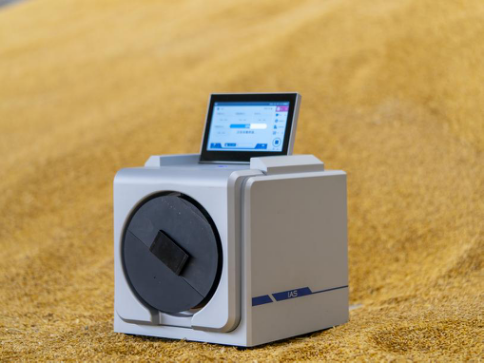
https://www.ias-glb.com/shop/ias-5100
Scenario 2: Feed Formula Optimization
Issue: Nutritional fluctuations in raw materials cause formula errors, impacting livestock growth.
NIRS Solution:
Real-time analysis of corn starch (60–75%) and wheat gluten (24–34%) content.
Dynamically adjust formulas, reducing nutrient waste by 10–15%.
Contact US
Product Information
Quantity
Unit
Piece
Support order samples, customization, wholesale direct, and complete payment. If the product you look for does not have corresponding customized content, pls fill out the form below to contact us, and we will reply ASAP.